Notes on “Superintelligence” by Nick Bostrom

Some notes on “Superintelligence” by Nick Bostrom, which is a bad book.

Summary: Bostrom sez that we might make superintelligences that are better than us. He doesn’t realise that saying there could be a qualitatively different kind of intelligence means that science and critical discussion are not universal methods of finding truth. If that’s true, then his whole discussion is pointless since it uses tools he claims are trash: critical discussion and science. Superintelligences might have motivations very different from us and make us all into paperclips, or use us to construct defences for it or something. He doesn’t seem to have any understanding at all of critical discussion or moral philosophy or how they might help us cooperate with AIs. Superintelligences might make us all unemployed by being super productive he sez. Or we might waste all the resources the superintelligences give us. He doesn’t discuss or refer to economics. It’s as if he doesn’t realise there are institutions for dealing with resources. And he also doesn’t seem to understand that more stuff increases economic opportunity, so if AIs make lots of cheap stuff people will have more opportunities to be productive. His proposed solution to these alleged problems is government control of science and technology. Scientists and AIs would be slaves of the govt.

I go through the book chapter by chapter, summarising and criticising.

Chapter 1 Bostrom sez vague stuff about the singularity. This is a prophecy of accelerating progress in something or other. Prophecy is impossible because what will happen in in the future depends on what we do in the future. What we will do depends on what knowledge we will have in the future. And we can’t know what knowledge we will have in the future, or how we would act on it without having the knowledge now. See The Beginning of Infinity by David Deutsch chapter 9 and The Poverty of Historicism by Karl Popper. Anyway, he gives an account of various technologies people have tried to use for AI. He eventually starts describing a Bayesian agent. The agent has a utility function and can update probabilities in that function. He sez nothing about how the function is created. He sez some stuff about AI programs people have written. He then starts quoting surveys of AI researchers (i.e. – people who have failed to make AI) about when AI will be developed as if such surveys have some kind of significance.

Chapter 2 Bostrom sez an AI would have be able to learn. He discusses various ways we might make AI without coming to a conclusion.

Chapter 3 Bostrom discusses ways a computer might be super intelligent. An AI might run on faster hardware then the brain. So it might think a lot of thoughts in the time it takes a human to think one thought. Thinking faster isn’t necessarily much use. People thought for thousands of years at the speed we think now without making much progress. He sez stuff about collective super intelligence: people can do smarter stuff by cooperating according to rules than they can individually. This is not very interesting since all the thinking is done by the people cooperating using those rules, so it’s not an extra level of thinking or intelligence. He sez a super intelligence might be qualitatively better than human intelligence. Qualitative super intelligence would imply that the scientific and rational worldview is false since it could understand stuff we couldn’t understand by rational and scientific methods. The stuff that can’t be understood by scientific and rational methods would interact directly or indirectly with all of the stuff we could understand  by rational methods. We would not be able to understand those interactions or their results, so we couldn’t really understand anything properly.

Chapter 4 vague prophecy stuff about the rate at which super intelligence might develop.

Chapter 5 includes a lot more vague prophecy. He sez govts might want to control super intelligence projects if they look like they might succeed other stuff like that. He sez AIs might maximise utility without taking into account the ways govts restrain themselves from doing stuff that maximises utility. He writes about deontological side constraints: I think this means principles like “don’t murder people” but he doesn’t explain. He doesn’t explain how utility is measured or anything like that. He doesn’t explain how you can know an option has more utility for somebody without giving him a choice between that option and others. He sez AI might be less uncertain and so act more boldly but he doesn’t explain any way of counting uncertainty. He doesn’t explain epistemology, which is dumb since the book is supposed to be about agents who create knowledge. He sez an AI wouldn’t have problems of internal coordination like a group of people. This is dumb since people have lots of internal conflicts.

Chapter 6 Bostrom sez our brains have a slightly increased set of capacities compared to other animals. He doesn’t realise that we’re qualitatively different from other animals. Humans can guess and criticise explanations, animals can’t. He sez a super intelligence might be able to do lots of stuff better than people and then take over the world. They might use nanotechnology or von Neumann probes or something. This is super vague and kinda dumb. If that sort of technology is available then it may be improved and made cheaper by capitalism till everyone can use it, so why wouldn’t everyone use it? So then the supposed super intelligence wouldn’t have a great advantage.

Chapter 7 Bostrom sez a super intelligence might have very different motivations than humans. It might want to maximise the production of paperclips. But we might design a super intelligence to have particular goals. Or it might be made by scanning a human brain or something so it has similar ideas to us. Or the super intelligence might do whatever is necessary to realise some particular goal, including making the whole Earth into defences to protect itself or something. He talks a lot about predicting the super intelligence’s behaviour. This is just prophecy, which is impossible. He also doesn’t mention objective moral standards or critical discussion as things that might help AIs and humans get along.

Chapter 8 Bostrom worries that an AI might act nice to lull us into a false sense of security before making us all into paperclips or whatever. Or the AI might try to do nice stuff by a bad means, like make u happy by putting electrodes in parts of the brain that produce pleasure. This is just more of the same crap as in chapter 7.

Chapter 9 Bostrom talks about controlling AIs so they won’t kill us or whatever. He considers limiting what the AI can do and dictating its motivations. He doesn’t consider critical discussion or moral explanations.

Chapter 10 discusses ways in which a super intelligence might be useful. It might be able to answer any question in a particular domain. As David Deutsch points out in The Fabric of Reality chapter 1, we already have an oracle that can tell us what will happen if we do thing X: it’s called the universe. This isn’t very useful. Being able to explain stuff is more important than prediction. Also, any particular oracle will be fallible and have some limitations. So again we’re back Bostrom ignoring the importance of critical discussion and explanation. A super intelligence might also act as a genie he sez. He sez we would have to design it so it would do what we intended rather than act in some way that formally does what we asked but is actually dumb. Again, critical discussions and explanations just don’t exist in Bostrom’s world.

Chapter 11 Bostrom talks about superintelligences making everyone unemployed. He doesn’t explain why people would be unemployed when cheap stuff made by AIs would open up more economic opportunities. He also sez AIs might produce lots of wealth that people would squander for some unexplained reason. He also sez that people might create lots of AIs on demand for particular kinds of work then get rid of them when the work is done. And people might make AIs work very hard so they are unhappy. He sez this might be avoided by lots of treaties limiting what people can do. This is all kinda dumb. He’s just arbitrarily saying stuff might happen without thinking about it. Like if you create AIs that can create knowledge, you should be interested in their objections to some proposed course of action since they might point a problem you didn’t notice.

Chapter 12 Bostrom discusses deciding what values AIs will have and how to impose them. He seems to think that values work by deciding on some goal and then pursuing it without any reconsideration. But even if AIs wanted to maximise the production of paperclips it wouldn’t make people into paperclips. Rather, the AI would have to work out all of the best stuff we know about how to make stuff, such as critical discussion and free markets. See Elliot Temple’s essay on squirrels and morality for more discussion of this point.

Chapter 13 More of the same. He finally has a discussion of epistemology. He is assuming Bayesian epistemology is true since he writes about priors. But Bayesian epistemology is wrong. Ideas are either true or false so they can’t be assigned probabilities. And the only way to create knowledge is through guessing and criticism, as explained by Karl Popper, see Realism and the Aim of Science, Chapter I and The Beginning of Infinity by David Deutsch chapter 4. The acknowledgements to the book say he consulted David Deutsch.

Chapter 14 sez the govt should control science to make superintelligences serve the common good. So scientists and superintelligences should be slaves to the govt.

Chapter 15 More of the same sort of trash as chapter 14.
Why are atoms stable in quantum mechanics?

In a previous post I explained why atoms are unable in classical physics. The post is about why atoms are stable in quantum mechanics.

Summary Atoms in quantum mechanics don’t suffer from the same radiation problem as atoms in classical mechanics. A quantum system exists in many instances that can interfere with one another on a small scale. As a result, on an atomic scale an electron doesn’t have a trajectory and so it can’t be said to accelerate and it doesn’t radiate. In addition, when the probability of finding an electron is highly peaked at a particular location, quantum mechanics makes the instances spread out. The potential produced by the nucleus pulls the electron instances toward the nucleus. Atoms can be stable because the spreading out produced by quantum mechanics and the attraction produced by the potential balance out.

In classical mechanics, an electron’s orbit around an atom is unstable because it emits the energy it would need to stay in orbit as light. And the electron does this because it is accelerating. To be able to say the electron is accelerating, it has to have a trajectory – a line it travels along. Then if the line changes direction or the electron speeds up along the line you can say it is accelerating. In quantum mechanics, systems sometimes don’t have trajectories.

Absence of microscopic trajectories in quantum mechanics

In quantum mechanics, particles are described very differently from how they are described in classical mechanics. Particles are more complicated than they look. Each particle exists as multiple instances. these instances are copies in the sense that they all obey the same rules. They are instances of a specific particle in the sense that they only interact with other instances of that particle. Sometimes two instances of a particle are different: they have different locations or different momentum or different values of some other measurable quantity.  Sometimes these instances are all fungible – there is literally no detectable physical difference between them. Two instances of the same particle can become different and then become fungible again in a way that depends on what happened to the different versions of the particle: this process is called quantum interference.

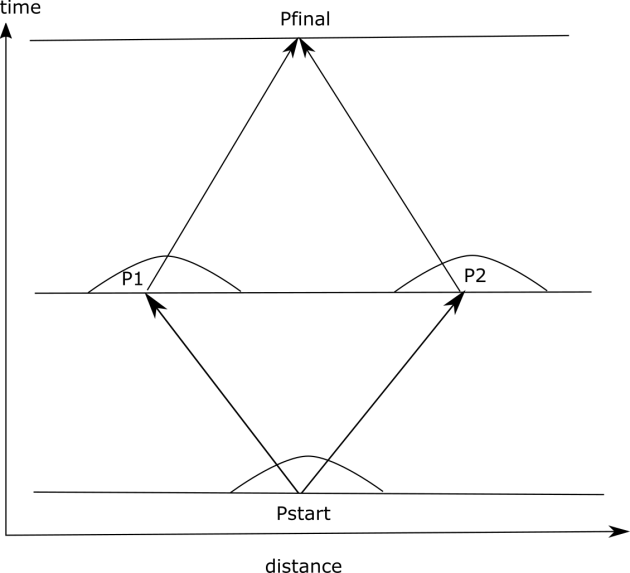
Now suppose you have an electron in empty space near some point Pstart. Consider a point Pfinal that some instances of the electron will reach later. How does those instances get there? First instances of the electron spread out from Pstart in all directions. Some instances go to points intermediate between Pstart and Pfinal: P1 and P2. Then some instances of the electron spread out from P1 and P2 in all directions. Some of those instances end up at Pfinal. Figure 1 shows this process with the little domes over the intermediate points indicating the instances moving in all possible directions. There is no explanation of how the electron moves that refers to just one trajectory. And none of the instances individually change direction either. At each point there is some instance coming in from any given direction and another instance leaving in the same direction. And all of the instances of the electron at a given point are fungible so you can’t tell whether the one that left in a given direction came in from that direction or not. So there is no trajectory and no acceleration.

electronpropagation

Figure 1 Instances of the electron become different and then come back together.

Now to deal with some objections you might have.

You may be thinking that people can measure where things are and this seems incompatible with there being lots of instances of the electron in different places. Quantum mechanics deals with this problem in the following way. When you do a measurement, the instances of the electron are divided up into sets. When you see some particular outcome of the measurement, the result means something like ‘this electron is within 5mm and 7mm of the corner of your desk.’ There are multiple sets of instances of the electron that give different measurement results like ‘this electron is within 0mm and 5mm of the corner of your desk’ or whatever. When you do the measurement, your instances and the instances of the measuring instrument are also divided into sets. Each of those sets acts as a record of some particular measurement result. For example, if you are detecting the electron with an instrument with a dial, there is a set of instances for each distinguishable position of the dial.

Why don’t you see multiple instances of yourself interfering in everyday life? Multiple instances of you do interfere in everyday life. They just interfere on a very small scale because it is difficult to arrange interference on a large scale. The reason it is difficult to arrange interference on a large scale is that large differences between instances can be recorded by measuring instruments and other interactions, e.g. – air molecules and light bouncing off your body. That measurement process changes the recorded instances. The only way to undo the change so the instances can become fungible again is to undo the transfer of information about the differences. You would have to track down all the light and air molecules and so on and arrange to exactly undo their interaction with you. This cannot be done with current technology so you don’t undergo quantum interference. As a result, the different instances of you don’t interfere with one another. The different instances of the objects you see around you don’t interfere with each other either. Rather, the instances form independent layers where each layer approximately obeys the laws of classical physics: parallel universes. For more explanation of quantum mechanics see The Fabric of Reality by David Deutsch, especially chapter 2, for more on quantum mechanics and fungibility see The Beginning of Infinity by David Deutsch, Chapter 11 and my post on fungibility.

The electron can have something that looks a bit like a trajectory. The electron can have more instances in some places than in others. The number of instances at different positions can be represented by a curve, like this (Figure 2):

electroncurve

Figure 2 A graph of number of instances with distance along some line for an electron.

If you look at a section of the curve, and find the area of the curve under that section, that tells you the probability of finding the electron in that region. In Figure 3, there is a higher probability of finding the electron in the red region since it has a higher area, so the probability of finding the electron between the two red lines is larger than the probability of finding it between the two green lines:

electroncurveint

Figure 3 A graph of the area under the curve in two different regions of the curve.

I said that there is a number of instances, but that number is continuous and the only way to know anything about it is by calculating or measuring probabilities.

If you look at the electron on a wide enough section of the curve, then the probability of finding the electron there will be close to 1. The curve changes continuously over time so the curve could move so the peak is in different places and that could look a bit like a trajectory:

electroncurvemotion

Figure 4 The curve for the electron moves around, and so the region where there is a large probability of finding the electron moves around. This is the closest thing to a trajectory in quantum mechanics.

For electrons on a large enough scale, and for large objects like a person or car, the trajectory approximation is very accurate. Things move by lumps of high probability moving from one place to another. But the scale of a single atom is small enough that the trajectory approximation doesn’t work.

Stability of atoms

The absence of trajectories by itself doesn’t explain the stability of atoms. It just explains why the problem of radiating accelerating charges doesn’t occur. To understand why atoms are are stable, let’s go back to the electron. To understand the next bit we have to know a little about how the number of instances curve changes over time. The simple version goes a bit like this:

the rate of change of the curve over time = -(curvature of the curve + the potential the electron is in).

The rate of change of the curve near a point is its slope. If the curve is very curvy, then the slope changes a lot. So the curvature is the rate of change of the rate of change of the curve. Figure 5 illustrates this with some lines near the curvy bit illustrating large change of slope, and in less curvy bit representing less change of slope.

electroncurvecurvature

Figure 5 The blue lines change gradient a lot over a small region, so that region has high curvature. The green lines don’t change gradient much and so the region with the green lines doesn’t have much curvature.

The rate of change of the curve over time = -curvature, so near a high peak the curvature is high and the curve gets flatter over time because it decreases at that point. Away from the peak the curvature is smaller and so the curve tends to get flatter more slowly over time. So the curvature term tends to flatten out the curve.

What about the potential? The potential is negative, as explained in the comments on the previous post. So the curve tends to get larger where the potential is large: near the nucleus. The electron can be a stable state that doesn’t change much over time if the flattening caused by the curvature term and the peaking cause by the potential match one another. In this interaction, the electron and proton are recording one another’s position, so their instances are divided up so that the electron and proton stick together.

That’s why atoms are stable in quantum physics.

Fake Constitutional Scruples

The British High Court recently decided that the government could not leave the European Union without a vote in Parliament. The politicians who brought this case claimed they had constitutional concerns. Their alleged scruples make no sense.

The government has the power to use force against those who disagree with it. If you think a law is wrong, the government can use violence to force you to follow it or lock you up for breaking it. You also have no choice about paying for the policies of the current government. If you like the government’s policy on harsher sentences for burglars and dislike the welfare state, you can’t fund one policy and not the other. If you tried to withhold some of the taxes imposed by the government, the government will ultimately lock you up for refusing to pay. This makes the government extremely dangerous. A constitution is a set of rules that constrains how the government can use force. Part of that constraint is that the constitution should specify some means by which the government can be held accountable and dismissed for incompetence or malice. So you can’t plead a constitutional scruple to stop the government from taking an action that will help restore accountability.

The European Union is an organisation that gives EU officials power without accountability. The EU also damages the accountability of British MPs since they have to pass laws to implement EU directives. Since politicians can’t control what the EU does they have excuses for failing to carry out promises to their constituents. So leaving the EU will make the government more accountable. As such, claiming constitutional scruples about leaving the EU makes no sense.

The excuse given for this ruling is that leaving the EU will take rights away from British people. This is rubbish. The EU takes rights away by passing laws that stop people from dealing with one another voluntarily. For example, if an employer wishes to hire you only on condition that you work more than 48 hours per week, he is not allowed to do that according to the EU’s working time directive. His right to choose the terms on which he deals with people has been taken by the EU. This is not an increase in rights for him. Nor is it an increase in rights for people who want to work those hours. Given the legal issues involved, employers will be less willing to offer such people what they want since they can’t make your employment conditional on working more than 48 hours per week. So the stated reason for the ruling makes no sense.

Rise of the robots is crap

From the Introduction to “Rise of the Robots: Technology and the Threat of a Jobless Future” by Martin Ford:

Beyond the potentially devastating impact of long-term unemployment and underemployment on individual lives and on the fabric of society, there will also be a significant economic price. The virtuous feedback loop between productivity, rising wages, and increasing consumer spending will collapse. That positive feedback effect is already seriously diminished: we face soaring inequality not just in income but also in consumption. The top 5 percent of households are currently responsible for nearly 40 percent of spending, and that trend toward increased concentration at the top seems almost certain to continue. Jobs remain the primary mechanism by which purchasing power gets into the hands of consumers. If that mechanism continues to erode, we will face the prospect of having too few viable consumers to continue driving economic growth in our mass-market economy.

The author of this book thinks that businessmen will pay a lot for robots when nobody will buy what the robots make.

Who will voluntarily make that investment?

This book is full of blank statements like the one above. Questions like the one I asked aren’t raised or answered.

The author is very lefty. A typical extract from Chapter 2:

The precipitous decline in the power of organized labor is one of the most visible developments associated with the rightward drift that has characterized American economic policy over the past three decades. In their 2010 book Winner Take All Politics, political scientists Jacob S. Hacker and Paul Pierson make a compelling case for politics as the primary driver of inequality in the United States. Hacker and Pierson point to 1978 as the pivotal year when the American political landscape began to shift under a sustained and organized assault from conservative business interests. In the decades that followed, industries were deregulated, top marginal tax rates on the wealthy and on corporations were cut to historic lows, and workplaces were made increasingly inhospitable to union organization. Much of this was driven not by electoral politics but, rather, by continuous lobbying on the part of business interests. As the power of organized labor withered, and as the number of lobbyists in Washington exploded, the day-to-day political warfare in the capital became increasingly asymmetric.

So businessmen asking not to have their money taxed away and their property controlled through regulation are assaulting the American political system? If you decline to pay taxes the govt uses force against you. If you don’t agree with a regulation and disobey it, the government may use force against you. Asking people not to use force against you isn’t assault.

“Rise of the robots” is a very bad book.

Abduction: a philosophical scam

A philosopher will often fool himself into believing he had made a valuable contribution to knowledge by making up a fancy word. In many cases, the word conceals confusion and gets in the way of simply rejecting a bad idea and moving on. Abduction is one of those words.

The Stanford Encyclopedia on abduction, linked above, sez:

Abduction or, as it is also often called, Inference to the Best Explanation is a type of inference that assigns special status to explanatory considerations. Most philosophers agree that this type of inference is frequently employed, in some form or other, both in everyday and in scientific reasoning.

The entry then gives an example:

One morning you enter the kitchen to find a plate and cup on the table, with breadcrumbs and a pat of butter on it, and surrounded by a jar of jam, a pack of sugar, and an empty carton of milk. You conclude that one of your house-mates got up at night to make him- or herself a midnight snack and was too tired to clear the table. This, you think, best explains the scene you are facing. To be sure, it might be that someone burgled the house and took the time to have a bite while on the job, or a house-mate might have arranged the things on the table without having a midnight snack but just to make you believe that someone had a midnight snack. But these hypotheses strike you as providing much more contrived explanations of the data than the one you infer to.

This sort of thing is not inference. It’s called guessing and criticism. You notice the stuff on the table. You guess that your housemate might have made a snack and not cleared the table. You guess that a burglar might have broken in and made a snack. But the burglar would have done other stuff like ransacking the house and stealing. If the house hasn’t been ransacked and nothing is missing, then the burglar guess doesn’t explain what happened at all. The burglar guess is ruled out by criticism. If you found out that your housemate interrupted a burglar having a snack you might reconsider since that would explain the lack of ransacking. This process of guessing and criticism is concealed by the term abduction.

Abduction also smuggles in the idea that ideas can be confirmed or justified. From the start of section 2 of the encyclopedia entry:

Precise statements of what abduction amounts to are rare in the literature on abduction. (Peirce did propose an at least fairly precise statement; but, as explained in the supplement to this entry, it does not capture what most nowadays understand by abduction.) Its core idea is often said to be that explanatory considerations have confirmation-theoretic import, or that explanatory success is a (not necessarily unfailing) mark of truth.

An idea is either true or false. You can use an argument to point out a problem for an idea. In the example of the snack stuff on the table, the lack of ransacking for the burglar theory. But the argument doesn’t show that anything is true or make truth of some particular idea more probable, or make it better in any way. It just creates a problem for an alternative idea.

Some people complain that this is too restrictive. They might think you can apply an idea without it being true. For example, there is no theory of gravity compatible with quantum mechanics. So QM has a problem. Should we never use it?  But QM is used in the semiconductor industry to help design computer chips. So then the rejecting stuff that is criticised idea seems too rigid. But we can explain why QM should work for chips even though there is no QM theory of gravity. Gravity interacts very weakly with the chips compared to other forces. So you would have to put the chip in a very strong gravitational field before a quantum theory of gravity would be relevant to its performance. So the criticism of using QM on computer chips has been answered and we can keep doing it. More generally, the solution to alleged strict restrictions imposed by criticism is to look at the criticism as an explanation and consider the relevance of that explanation to the problem you are trying to solve. If the explanation behind the criticism is irrelevant then the criticism has been answered.

Anyway, abduction is a scam. Philosophers use it to fool themselves into thinking they understand knowledge and have good ideas about it when they don’t.

The Gettier paper is rubbish

In 1963 Edmund Gettier wrote a philosophy paper called Is justified true belief knowledge? In this paper, Gettier comes up with an example that supposedly criticises the justified true belief theory. Smith has been told by the company president that Jones will get a job. Smith also thinks that Jones has ten coins in his pocket because he counted the coins. So Smith thinks the man who will get the job has ten coins in his pocket. Gettier claims that Smith’s claims are justified. But actually Smith is going to get the job. Smith has ten coins in his pocket, so it happens to be true that a man with ten coins in his pocket will get the job. So Smith has a justified true belief. But Gettier claims this justified true belief isn’t knowledge.

Philosophers love the Gettier paper, but the paper is stupid. No ideas are ever justified, in the sense of being shown to be true or more probable or better. Argument doesn’t work like that. The premises of any given argument may be wrong. Its rules of inference may be wrong. So the argument may be wrong. You can’t eliminate the possibility of error. There is no magical way of conferring truth or partial truth or higher status on some conclusion. It’s either right or wrong and you can’t prove whether it is right or wrong or assign probability to it being right or wrong in any sensible way. The Gettier argument requires that justification is possible, but it’s not so the whole argument is sunk before it gets started.

Popper had refuted the JTB theory in 1961 in his paper On The Sources Of Knowledge And Of Ignorance and he clarified further in “Realism and the Aim of Science”. So there is no reason to fawn over the Gettier paper. The paper is just wrong.

There is another problem with the Gettier paper. You can’t really learn anything useful from it. Popper’s knowledge and ignorance paper explains that there are no privileged sources of knowledge and so that you should be critical about all your ideas:

The question of the sources of our knowledge like so many authori­tarian questions, is a genetic one. It asks for the origin of our knowledge, in the belief that knowledge may legitimize itself by its pedigree. The nobility of the racially pure knowledge, the untainted knowledge, the knowledge which derives from the highest authority, if possible from God: these are the (often unconscious) metaphysical ideas behind the question. My modified question, ‘How can we hope to detect error?’ may be said to derive from the view that such pure, untainted and certain sources do not exist, and that questions of origin or of purity should not be confounded with questions of validity, or of truth.

Gettier claims Smith counted the coins in someone else’s pocket, and that this justifies claiming there are ten coins in somebody’s pocket. The authoritative source of the count is Smith. But this is incredibly dumb. Did Smith see Jones take coins out of his pocket and ask if those were all the coins? If so, perhaps Jones thought “this guy’s a bit fucking weird asking how many coins I have in my pocket, I better lie in case he’s going to mug me.” Or did Smith stick his hands in Jones’ pockets and root around in them? There is a lot of potential for error in this example.

The president of the company says Jones will be hired. So what? Maybe he will discuss Jones with other people and change his mind. The hiring may not be his decision at all. the president of a corporation has powers described by the bylaws of the company in question and may not give him control over hiring decisions. Again, there is a lot of potential for error here.

There really isn’t anything good about the Gettier paper. The fact that philosophers like it reflects poorly on philosophers and should not be regarded as a reason to read the paper.

Division of Labour

This is my answer to a Philosophy Stack Exchange question about the division of labour. I’ve put the text below in case it gets deleted or something.

The division of labour is a “micro-level” as well as a societal phenomenon.

It means that different individuals are “coerced” into doing different parts of larger projects and that the labour is divided rather than produced by any single or by the preferences of a single individual only.

This of course has numerous implications for e.g. the working lives of individuals. Some are coerced into different jobs than others. Some are coerced into unfun or unfulfilling jobs. Some are expressing other than their genuine interests. But some things still need to be done.

The division of labour is just another name for people specialising on stuff they are good at.

It is true that some things need to be done. Sometimes they are done as a result of people doing stuff that is boring. For example, working on an assembly line may be boring if the worker has to do the same task over and over again. But why should a boring task should have to be done by a person? If a person can do X, then why doesn’t he write down an explanation of how to do X and construct a machine to do it? The answer is that he doesn’t know how to do this, and he doesn’t want to learn.

A machine to do the assembly worker’s task would be an improvement in the vast bulk of cases. Machines don’t need to go to the toilet or to lunch. They don’t make mistakes through boredom or carelessness. So there need not be any downside.

Sometimes an employer would not welcome such an innovation and wouldn’t know how to evaluate it. But in that case, there is nothing to stop the worker from solving the problem in his spare time and starting his own business, other than lack of inclination to do what is required.

You might say that this amounts to coercing the assembly line worker. But what has happened is that the worker has been offered a range of options for how to live his life, and has picked one of the options. He could have decided not to take the options on offer but create his own opportunity. As long as other people will voluntarily provide resources, he can do whatever he wants on the free market. There are people who play video games professionally. There are people who have sex professionally.

The only alternative to people voluntarily providing resources is to use or threaten physical violence against them. This is a bad idea partly because it will prevent people from acting on objections to the plan being imposed by force. If another person objects to some idea and declines to provide resources, you should be interested in understanding his objection. You might be able to answer the objection. And if you can’t meet the objection, you may have a bad idea and you should want to replace that bad idea. If you don’t want to replace your bad ideas, that’s your fault: you suck.

“Oh, Alan,” I hear you cry. “You’ve got me all wrong. I don’t want to use force. I just want the workplace to be democratic. Everybody will help make the decisions about what to do.” But this does not address the actual problem that leads to people doing stuff they don’t want. The problem is that some people don’t want to create new knowledge and take real responsibility for their lives. Such a person prefers to do a shitty job he hates instead of taking responsibility. If you want such people to take responsibility, you will have to coerce them unless you first come up with an argument to change their minds.

There is a further problem. Democracy doesn’t fit this situation. Democracy is an attempt to solve the following problem. A society with millions of people needs laws but not everybody is inclined to help write them. So then you have some people who specialise in doing that sort of thing: politicians. Voting is a mechanism to throw out incompetent or malicious politicians. If enough people vote for some other candidate, the politician loses his job if people don’t like the results he produced. They don’t have to argue with him about it, they can just remove him from office. But if you are in a small group at work, you need not vote. You can discuss a topic until you all reach a position you find unproblematic. If you adopt voting instead, then you won’t reach such a position and some people won’t like the position that was adopted as a result of the vote. You will just recreate the problem you wanted to solve.

If you want to understand more see

http://fallibleideas.com/

and ask questions at the associated discussion group:

https://groups.yahoo.com/neo/groups/fallible-ideas/info.

Why we should brexit 2

On June 23 2016, there will be a referendum on whether the UK should stay in the EU.

In a previous post I pointed out that the EU is not accountable in the sense that there is no way to get rid of specific policies or leaders. I’m going to point out another problem with the EU that is not clearly discussed.

In the European parliament, parties from different countries commonly enter into coalitions with one another. Political speeches, policies and platforms are usually as clear as mud when you read them in your native language. And a lot of your judgement of policies and parties takes advantage of common cultural knowledge in your country. For example, the right wing in the US is recognisably different from the right in the UK. The right wing in the UK consists of people who support the welfare state unambiguously and boast that they can fund it more efficiently than the left wing. The whole political difference between the left and the right in Britain is about how efficiently the welfare state can work for some vague notion of efficiency. In the US by contrast, there are at least some right wing politicians who are willing to say that at least some parts of the welfare state are a terrible idea, e.g. – government healthcare provision. So right wing means something different in the UK (no difference in principle at all from the left) and in the US (at least some difference in principle according to some people). Since people voting in the European elections can’t know enough to make a reasonable judgement about coalition partners, they can’t know enough to change or remove policies or leaders.This makes the EU unaccountable by any reasonable standard.

Another issue with this referendum is the predictions made by both sides about what will happen if we leave or stay. Nobody knows what will happen. If we leave, what will happen will depend on negotiations made after we leave. Nobody can predict the content of these negotiations. New knowledge will be created during the negotiations and we can’t foresee its content since if we could foresee its content we would already have that knowledge. So nobody knows what will happen. The remain side in particular seem keen to say stuff like we won’t be able to trade with Europe, or that Europe will go to war (over what?) and holidays will be more expensive and all sorts of other stuff that they can’t possibly know. The people saying such things are stupid or lying or both.

Animals shouldn’t have rights

Many people take for granted the claim that animals should have some rights. Exactly what rights animals should have varies from one claimant to another. Some people might say animals should have a right not to have pain inflicted on them, but not the right to vote. This idea is based on misunderstandings of rights and of human beings and animals.

One problem is that many people seem to think that rights are a sort of social nicety, but they are wrong. A right is an enforceable claim to something. For example, if I have a right to own some piece of property, then if somebody takes the property, I have a claim to get the property back. And it’s not just the case that I can say ‘pretty please, give me the property back’. I can call the police and they may use force to get the property back and detain the person who took it. A right is not a polite request for something, or indeed a request of any kind. When you say ‘animals should have rights’, you’re not saying that it would be a good idea for people to treat dogs well. Rather, you’re saying that if a person doesn’t treat a dog well, then people can and should use force directly or indirectly to stop him from treating the dog badly. If you wouldn’t be willing to say that a person should be thrown in jail for violating the alleged right, then you shouldn’t call it a right.

Under what circumstances should a particular thing be granted rights? I don’t think anyone would say that a lump of concrete should have rights. There are a couple of reasons for this. The concrete itself does not ask for rights. In addition, the concrete will not act very differently if  we say it has rights and treat it accordingly. By contrast, if you beat a person up, he will claim that what you’re doing is wrong and that you should be held accountable for your actions. He will also not be inclined to deal with you after you have beaten him up. So it makes a difference whether you treat other people according to their rights or not, both to them and to you. But it is not enough for there be a difference of some kind depending on how you treat an object. If that were the case, then my computer should have rights since it will stop working if I hit it with a sledgehammer.

If I respect a person’s rights, he can go off and do things independently of me that may benefit me, directly or indirectly. He could become a computer programer and help write a great game. He could compose some music. He could become a doctor or nurse, and help save people who can produce goods from which I can benefit, or his medical treatment might save my life or relieve some pain or something like that. My computer doesn’t act the same way. The only way we know of to get a computer to do something is to give it suitable instructions. Those instructions may be written by me or by other people, but there is always a person giving the orders. Nothing useful happens without those orders. The person can produce a potentially open ended stream of benefits for me and for others. The computer can’t do this.

Why can a person do this, but not a computer? The person is capable of creating new explanatory knowledge. A person can create knowledge about music, or physics, or how to lay out a retail store, or how to cut hair, or anything else. Computers can’t create new explanatory knowledge. This is a qualitative difference, not a quantitative difference. The idea that it is possible for us to understand anything about how the world works is required to make the rational, scientific worldview work. If there is a restriction on what sort of things it is possible for people to explain, then this fundamentally means we can’t explain anything. If there was such a limitation on being able to explain parsnips, say, then it would be impossible for us to understand things that interact with parsnips. And we would then be unable to understand things that interact with things that interact with parsnips and so on. So there is a qualitative difference between people, who can understand how the world works arbitrarily well, and computers as they are currently programmed.

There would be another problem with granting a computer rights. The computer can’t give or withhold consent to be treated in a certain way. If I have a right to control a piece of property, that means I can consent to give it up if I want to. If I have a right to control what substances I put in my body, I have the right to consent to put something in my body or not.

The question of whether animals should have rights has a lot to do with whether an animal is more similar to a person or a computer in the respects I explained above. It might appear obvious to you that the animal is more like a person. If you try to torture or kill an animal it will fight back, as a person would. The animal will make noises that sound a lot like the noises that a person makes when he is angry or in pain. And animals are made out of the same kinds of material as humans, muscle, bone, brain, nerves and so on. And an animal’s nervous system is, in many respects, similar to a person’s. So you may think that what is going on inside a screaming animal is the same as what is going on inside a screaming person. So then it makes a difference to the animal how you treat the animal.

If you made this argument, you would be wrong. The problem is that when a person feels pain, his interpretation of that experience is part of what makes it bad. The person understands that he might die, or be unable to perform certain tasks, or it might change his view of the world and make him less inclined to go out, or whatever. Such interpretations depend on his ability to understand the world. Without that ability, no such interpretation would exist. And other animals lack that ability. Dogs don’t write plays, or songs, or come up with scientific theories. It’s not that some dogs do those things, and others don’t. Not a single dog in the whole of history has ever done any of those things.

You might think that some species are smarter than dogs in some way. For example, bonobos have used sign language. But as recorded in Kanzi: The Ape on the Brink of the Human Mind by Sue Savage-Rumbaugh and Roger Lewin, bonobos never managed to understand a sentence as simple as ‘put the coke can in the trash can.’ What was going on in the bonobos was something very different from what happens when a person learns. An animal has some finite set of behaviours it can enact, determined by its genes. It has some set of features of the world that it can discriminate, again, determined by its genes. And the animal can try out combinations of the set of behaviours until the results meet some criteria encoded in its brain by its genes. See R. W. Byrne’s paper Imitation as behaviour parsing and The Beginning of Infinity Chapter 16, Section ‘How do you replicate a meaning?’ starting around p. 401.

Some people might say that we evolved from animals so we can’t be qualitatively different. But evolution has give rise to qualitative differences, e.g. – differences between multicellular organisms and single celled organisms. Differences between animals that perceive light and those that are blind. And since humans are qualitatively different, there pretty much had to be other species that were similar to us in many respects, except in their ability to understand the world.

Since animals can’t understand the world, an animal does not have the potential to produce an open-ended stream of benefits in the same way a person can. We gain nothing by granting them rights. Administering any rights granted to animals would also be a problem since the animals can’t give or withhold consent. A person can consent to eat spicy food, even if it makes him have an experience in which his mouth feels like it is burning and tears are running down his cheeks. But we know he wants this because he can tell us. So how are we to decide whether an animal wants spicy food? The animal can’t tell us.

Granting animals rights is a mistake. We are throwing out the actual interests of people for something that doesn’t benefit us and can’t benefit animals. We may wish to treat animals well for a variety of reasons. Some animals look cute and we don’t want to hurt them. Some animals produce better meat or eggs or milk or whatever if treated in specific ways. This does not require giving animals rights. We have nothing to gain and a lot to lose by trying to grant rights to animals.

EU vs the internet

A European Commission (EC) document called Online platforms and the digital single market has been leaked. It has content that has been described as a link tax, but the article doesn’t provide page references or long quotes for most of its claims. I think the policy described as a link tax is a bad idea, but I wouldn’t describe it as a tax. It’s more like just breaking contracts when the EC happens to feel like it.

On page 9 of the document the problem the EC wants to address is described as follows:

New forms of online content distribution have emerged which may involve several actors, and where, for instance, content is distributed through platforms which make available copyright protected content uploaded by end-users. While these services attract a growing audience and gain economic benefits from the content distribution, there is a growing concern as to whether the value generated by some of these forms of online content distribution is shared in a fair manner between distributors and right holders. In reply to the public consultation, right holders across several content sectors reported that their content is increasingly used without authorisation or through licencing agreements, which, in their view, contain unfair terms.

The emphasis and wrong spelling of “licensing” are in the original.

On p.10, the EC describes what it intends to do about this problem:

in the next copyright package, to be adopted in autumn 2016, the Commission will aim at ensuring fair allocation of the value generated from the online distribution of copyright-protected content by online platforms whose businesses are based on the provision of access to copyright-protected material.

The emphasis in the quote is the same as in the original.

The first problem with this “solution” is that the EC openly states that some of the content is shared under license agreements. This means that the EC will be in the position of breaking the terms of contracts. Defenders of the EC might say they are going to decide on the basis of a “fair allocation”, but there is no such standard of fairness. If you make a contract, you should either stick to the terms or negotiate a new agreement both parties can accept. Otherwise, the other party to the contract just gets shafted and has no recourse. There is no fair way to fuck somebody over like that.

The second problem is that as anyone knows who has followed what has happened on YouTube over the past few years, the copyright as it stands has some major problems. It is already difficult to quote material produced by somebody else, even for the purposes of commentary. Those concerns don’t matter to the EC. They are accountable to nobody. Voters can’t vote them out. Nor can anyone else. So how are they supposed to decide what to do? The EC have to get their information about problems to address from somebody, so they get it from whoever can afford to lobby them.

This document is an example of why the UK should leave the EU. In its current state, the EU can’t be reformed or saved because it has no means of error correction. Sticking around in the hope that maybe the EU will learn a lesson that it has failed to learn over the past several decades, and which it has no means to learn, would be a bad idea.