Why are atoms stable in quantum mechanics?

In a previous post I explained why atoms are unable in classical physics. The post is about why atoms are stable in quantum mechanics.

Summary Atoms in quantum mechanics don’t suffer from the same radiation problem as atoms in classical mechanics. A quantum system exists in many instances that can interfere with one another on a small scale. As a result, on an atomic scale an electron doesn’t have a trajectory and so it can’t be said to accelerate and it doesn’t radiate. In addition, when the probability of finding an electron is highly peaked at a particular location, quantum mechanics makes the instances spread out. The potential produced by the nucleus pulls the electron instances toward the nucleus. Atoms can be stable because the spreading out produced by quantum mechanics and the attraction produced by the potential balance out.

In classical mechanics, an electron’s orbit around an atom is unstable because it emits the energy it would need to stay in orbit as light. And the electron does this because it is accelerating. To be able to say the electron is accelerating, it has to have a trajectory – a line it travels along. Then if the line changes direction or the electron speeds up along the line you can say it is accelerating. In quantum mechanics, systems sometimes don’t have trajectories.

Absence of microscopic trajectories in quantum mechanics

In quantum mechanics, particles are described very differently from how they are described in classical mechanics. Particles are more complicated than they look. Each particle exists as multiple instances. these instances are copies in the sense that they all obey the same rules. They are instances of a specific particle in the sense that they only interact with other instances of that particle. Sometimes two instances of a particle are different: they have different locations or different momentum or different values of some other measurable quantity.  Sometimes these instances are all fungible – there is literally no detectable physical difference between them. Two instances of the same particle can become different and then become fungible again in a way that depends on what happened to the different versions of the particle: this process is called quantum interference.

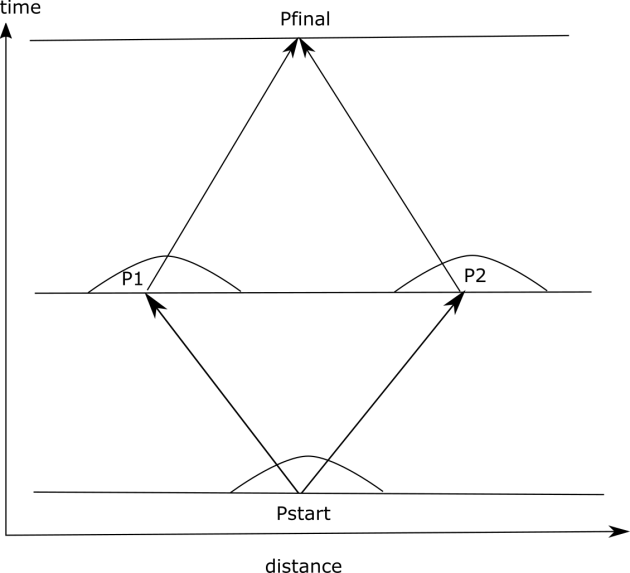
Now suppose you have an electron in empty space near some point Pstart. Consider a point Pfinal that some instances of the electron will reach later. How does those instances get there? First instances of the electron spread out from Pstart in all directions. Some instances go to points intermediate between Pstart and Pfinal: P1 and P2. Then some instances of the electron spread out from P1 and P2 in all directions. Some of those instances end up at Pfinal. Figure 1 shows this process with the little domes over the intermediate points indicating the instances moving in all possible directions. There is no explanation of how the electron moves that refers to just one trajectory. And none of the instances individually change direction either. At each point there is some instance coming in from any given direction and another instance leaving in the same direction. And all of the instances of the electron at a given point are fungible so you can’t tell whether the one that left in a given direction came in from that direction or not. So there is no trajectory and no acceleration.
electronpropagation

Figure 1 Instances of the electron become different and then come back together.

Now to deal with some objections you might have.

You may be thinking that people can measure where things are and this seems incompatible with there being lots of instances of the electron in different places. Quantum mechanics deals with this problem in the following way. When you do a measurement, the instances of the electron are divided up into sets. When you see some particular outcome of the measurement, the result means something like ‘this electron is within 5mm and 7mm of the corner of your desk.’ There are multiple sets of instances of the electron that give different measurement results like ‘this electron is within 0mm and 5mm of the corner of your desk’ or whatever. When you do the measurement, your instances and the instances of the measuring instrument are also divided into sets. Each of those sets acts as a record of some particular measurement result. For example, if you are detecting the electron with an instrument with a dial, there is a set of instances for each distinguishable position of the dial.

Why don’t you see multiple instances of yourself interfering in everyday life? Multiple instances of you do interfere in everyday life. They just interfere on a very small scale because it is difficult to arrange interference on a large scale. The reason it is difficult to arrange interference on a large scale is that large differences between instances can be recorded by measuring instruments and other interactions, e.g. – air molecules and light bouncing off your body. That measurement process changes the recorded instances. The only way to undo the change so the instances can become fungible again is to undo the transfer of information about the differences. You would have to track down all the light and air molecules and so on and arrange to exactly undo their interaction with you. This cannot be done with current technology so you don’t undergo quantum interference. As a result, the different instances of you don’t interfere with one another. The different instances of the objects you see around you don’t interfere with each other either. Rather, the instances form independent layers where each layer approximately obeys the laws of classical physics: parallel universes. For more explanation of quantum mechanics see The Fabric of Reality by David Deutsch, especially chapter 2, for more on quantum mechanics and fungibility see The Beginning of Infinity by David Deutsch, Chapter 11 and my post on fungibility.

The electron can have something that looks a bit like a trajectory. The electron can have more instances in some places than in others. The number of instances at different positions can be represented by a curve, like this (Figure 2):

electroncurve

Figure 2 A graph of number of instances with distance along some line for an electron.

If you look at a section of the curve, and find the area of the curve under that section, that tells you the probability of finding the electron in that region. In Figure 3, there is a higher probability of finding the electron in the red region since it has a higher area, so the probability of finding the electron between the two red lines is larger than the probability of finding it between the two green lines:

electroncurveint

Figure 3 A graph of the area under the curve in two different regions of the curve.

I said that there is a number of instances, but that number is continuous and the only way to know anything about it is by calculating or measuring probabilities.

If you look at the electron on a wide enough section of the curve, then the probability of finding the electron there will be close to 1. The curve changes continuously over time so the curve could move so the peak is in different places and that could look a bit like a trajectory:

electroncurvemotion

Figure 4 The curve for the electron moves around, and so the region where there is a large probability of finding the electron moves around. This is the closest thing to a trajectory in quantum mechanics.

For electrons on a large enough scale, and for large objects like a person or car, the trajectory approximation is very accurate. Things move by lumps of high probability moving from one place to another. But the scale of a single atom is small enough that the trajectory approximation doesn’t work.

Stability of atoms

The absence of trajectories by itself doesn’t explain the stability of atoms. It just explains why the problem of radiating accelerating charges doesn’t occur. To understand why atoms are are stable, let’s go back to the electron. To understand the next bit we have to know a little about how the number of instances curve changes over time. The simple version goes a bit like this:

the rate of change of the curve over time = -(curvature of the curve + the potential the electron is in).

The rate of change of the curve near a point is its slope. If the curve is very curvy, then the slope changes a lot. So the curvature is the rate of change of the rate of change of the curve. Figure 5 illustrates this with some lines near the curvy bit illustrating large change of slope, and in less curvy bit representing less change of slope.

electroncurvecurvature

Figure 5 The blue lines change gradient a lot over a small region, so that region has high curvature. The green lines don’t change gradient much and so the region with the green lines doesn’t have much curvature.

The rate of change of the curve over time = -curvature, so near a high peak the curvature is high and the curve gets flatter over time because it decreases at that point. Away from the peak the curvature is smaller and so the curve tends to get flatter more slowly over time. So the curvature term tends to flatten out the curve.

What about the potential? The potential is negative, as explained in the comments on the previous post. So the curve tends to get larger where the potential is large: near the nucleus. The electron can be a stable state that doesn’t change much over time if the flattening caused by the curvature term and the peaking cause by the potential match one another. In this interaction, the electron and proton are recording one another’s position, so their instances are divided up so that the electron and proton stick together.

That’s why atoms are stable in quantum physics.

Why atoms are unstable in classical physics

Why are atoms unstable in classical physics?

Summary: The nucleus of an atom is a positive charge, an electron is a negative charge. Positive charges attract negative charges as a result of electric forces between them. This attraction causes electrons to orbit nuclei according to classical physics. But electron orbits are unstable in classical physics. Charges exert forces on other charges and those forces are described by fields. The field tells you what the force on a charge would be if the charge was at a particular position. An electric field describes the forces on a static charge from another static charge. A magnetic field is basically the electric field produced by a charge moving at constant speed. Electric and magnetic fields are so closely related that they are often described in terms of a single field called the electromagnetic field. An accelerating charge produces waves in the electromagnetic field since the field has to transition between its electric and magnetic components and vice versa. Those waves carry away energy from the accelerating charge. An orbiting electron is an accelerating charge, so this mechanism causes it to lose energy and spiral into the nucleus. This happens in a very short time, around 10^{-11}s.

An electron accelerates when it is orbiting

The nucleus of an atom is a positive charge, an electron is a negative charge. Positive charges attract negative charges as a result of electric forces between them. This attraction causes electrons to orbit nuclei according to classical physics.

An electron orbiting a nucleus is changing direction at every point on its orbit, as illustrated in Figure 1:

circorbit

Figure 1 – An object in a circular orbit is accelerating at every point on the orbit. The same would be true for an elliptical orbit.

As a result, its velocity is changing: it is accelerating. An accelerating charge radiates, so the electron loses energy by radiating. Since the electron is losing energy it falls into the nucleus. You might think that the electron could lose energy without falling into the nucleus. A car loses energy in the form of stored fuel when you drive it, but it doesn’t just fall into a ditch as a result. But an electron doesn’t store fuel. All of its energy is tied up in its motion since it has nowhere else to store the energy. So when the electron loses energy it loses speed and it falls toward the nucleus as a result.

Why does an accelerating charge radiate? To understand that, we have to know some stuff about charges in motion, fields and forces.

Forces and fields

A force is any influence on a physical system that can cause it to accelerate or decelerate: Newton’s first law of motion. The size of the force on an object is the mass of the object times the acceleration produced by the force: Newton’s second law of motion. If physical system 1 exerts a force on system 2, then system 2 exerts the same amount of force on system 1: Newton’s third law of motion.

The nucleus exerts a force on the electron before it comes in contact with the electron. As a result, at each point in space there is a vector that describes the forces an electron would experience if it was at that point. A particle with a different charge would experience a different force. The electric force depends linearly on charge. So it is useful to define a vector at each point in space that doesn’t depend on the size of the charge of the electron that can be used to help describe the forces on a particle without  giving a charge in advance. The electric field is a vector valued quantity defined at every point that gives the force applied on a charged particle at that point due to other static charges.

If you had a charged object much larger than an electron, the field might be different at different parts of the object. As a result different parts of the object would experience different amounts of force. So larger objects introduce additional complications to trying to understand what’s going on. It’s more useful for this discussion to consider objects that are so small that the change in the field over those objects is so small it produces negligible internal forces: such objects are called point charges.

You can think of the electric field of a particle in terms of field lines. Field lines are a picture representation of the field. The field lines have arrows on them. The arrows point in the direction a positive charge would move in that field. More lines per unit area means more force.

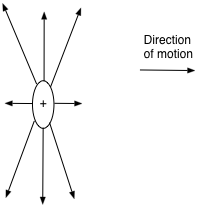
A point charge will have field lines going out evenly in every direction. So a point positive charge would look like this (figure 2):

pointcharge

Figure 2 – Electric field lines of a stationary charge.

A positive charge would move toward a negative charge. So a point negative charge would have a similar diagram with the lines pointing toward it.

Moving charges

What about a moving charge? The field lines in the direction of the charge’s motion would shrink in that direction. Why objects shrink in the direction of their motion is explained by special relativity. As a result, the field lines get shorter parallel to the charge’s motion, but not at right angles to it. So all the field lines that are not perfectly parallel to the particle’s direction of motion change their slope so they are pointing at a steeper angle to the direction of motion (figure 3):

velocityatom

Figure 3 – Field lines of a charge moving at a constant velocity.

So it’s like there is more charge at right angles to the charge’s direction of motion. So the field at right angles to the charge gets larger.

There is one more issue to understand before I can explain why accelerating charges radiate: the relationship between electricity and magnetism. Magnets exert a force on charged particles like electrons. This effect was used in televisions until about 5-10 years ago. The inside of the television screen was coated with pixels that included materials that would glow different colours when bombarded with electrons. The TV would produce a beam of electrons and move it back and forth across that screen to produce images in quick succession. The path of the electrons was controlled by a magnet that deflected the beam to the appropriate place on the screen. Magnetic forces on a particle depend on the particle’s velocity and charge. At any given point in space, there is a vector that could be combined with the charge and velocity of a point charge at that point to give the magnetic force on that point charge: this vector is called the magnetic field.

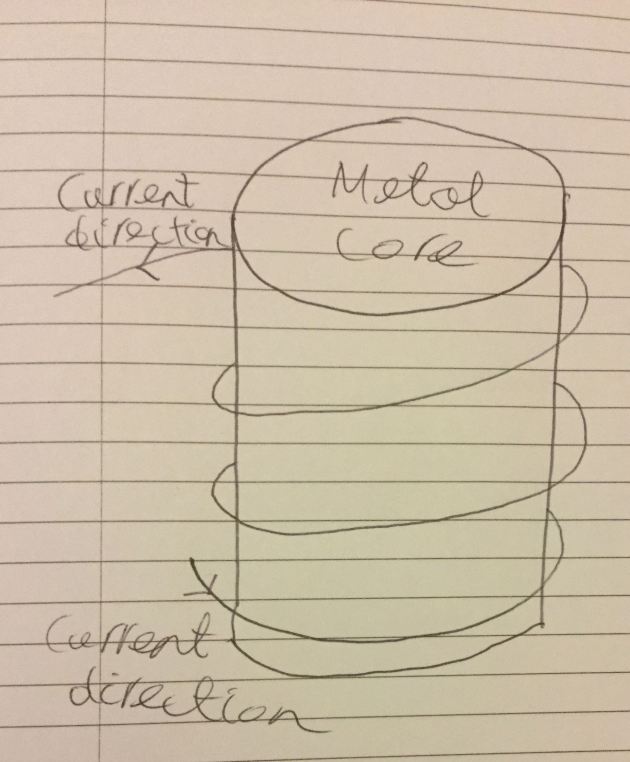
Changing electric fields give rise to magnetic fields and vice versa. You can see this effect in action in some scrapyards where people use cranes with electromagnets. These cranes have a lump of iron with wires wrapped around it in a circular pattern, like so:

electromagnet

This arrangement produces a magnetic field running through the curves of the coil. How do the moving charges in the wire produce a magnetic field?

Consider a wire with current flowing through it. The electrons in the wire are moving and the nuclei of the atoms in the wire are not. As noted with the moving charge in the picture above this gives the electrons a larger field at right angles to their motion. That field looks like a magnetic field to a charge outside the wire. The magnetic field lines are at right angles to the line between the wire and the point where the field is being calculated. As a result, there is a field inside the coil pointing through the coil. So magnetic fields are a result of moving charges.

Whether a charge is moving is just a matter of your velocity relative to the charge. So an electric field is also the same as a moving magnetic field. Since electric and magnetic fields are so closely related they are usually considered to be aspects of a single field called the electromagnetic field.

You might be thinking that permanent magnets don’t need to have electricity running through them to work. In permanent magnets, the magnetic field is produced by spinning electrons whose spins are aligned with one another. So the magnetic field in such magnets is produced by the motion of charges.

Accelerating charges

We can now get back to explaining why accelerating charges radiate. An electromagnetic wave is a pattern of changes in electric and magnetic fields that can move. So if an accelerating charge generates  changing electric and magnetic fields, then it radiates.

The laws of physics don’t change at different speeds: an increase from 0 speed to 5, or 5000 speed to 5100 follow the same laws. So you can understand what’s going on by considering the situation where the charge starts stationary and then starts moving.

The charge starts out with field lines like those in figure 1, then the lines change to resemble the field lines in figure 2. This happens at a finite speed so the field lines further from the charge look like those in figure 1. The lines closer to the charge look like those in figure 2. Between those two sets of lines there has to be a transition in which the lines change, as illustrated in figure 4:

acceleratingcharge

Figure 4 – An illustration of the transition in field lines in an accelerating charge.

The circle is just there to illustrate the spherical symmetry of the field lines further out from the charge. This transition produces changing electromagnetic fields that spread out over time, i.e. – radiation. More generally, an accelerating charge makes components of the field transition from being electric to being magnetic and vice versa. These changes produce patterns in the electromagnetic field that move away from the accelerating charge: the charge radiates.

Since an electron is an accelerating charge, it radiates. This radiation leads to the electron losing energy and falling into the nucleus of an atom in classical physics. As a result, atoms are unstable in classical physics. Since electromagnetic fields are strong, the electron’s orbit would decay quickly in a time of the order 10^{-11}s.

Fake Constitutional Scruples

The British High Court recently decided that the government could not leave the European Union without a vote in Parliament. The politicians who brought this case claimed they had constitutional concerns. Their alleged scruples make no sense.

The government has the power to use force against those who disagree with it. If you think a law is wrong, the government can use violence to force you to follow it or lock you up for breaking it. You also have no choice about paying for the policies of the current government. If you like the government’s policy on harsher sentences for burglars and dislike the welfare state, you can’t fund one policy and not the other. If you tried to withhold some of the taxes imposed by the government, the government will ultimately lock you up for refusing to pay. This makes the government extremely dangerous. A constitution is a set of rules that constrains how the government can use force. Part of that constraint is that the constitution should specify some means by which the government can be held accountable and dismissed for incompetence or malice. So you can’t plead a constitutional scruple to stop the government from taking an action that will help restore accountability.

The European Union is an organisation that gives EU officials power without accountability. The EU also damages the accountability of British MPs since they have to pass laws to implement EU directives. Since politicians can’t control what the EU does they have excuses for failing to carry out promises to their constituents. So leaving the EU will make the government more accountable. As such, claiming constitutional scruples about leaving the EU makes no sense.

The excuse given for this ruling is that leaving the EU will take rights away from British people. This is rubbish. The EU takes rights away by passing laws that stop people from dealing with one another voluntarily. For example, if an employer wishes to hire you only on condition that you work more than 48 hours per week, he is not allowed to do that according to the EU’s working time directive. His right to choose the terms on which he deals with people has been taken by the EU. This is not an increase in rights for him. Nor is it an increase in rights for people who want to work those hours. Given the legal issues involved, employers will be less willing to offer such people what they want since they can’t make your employment conditional on working more than 48 hours per week. So the stated reason for the ruling makes no sense.